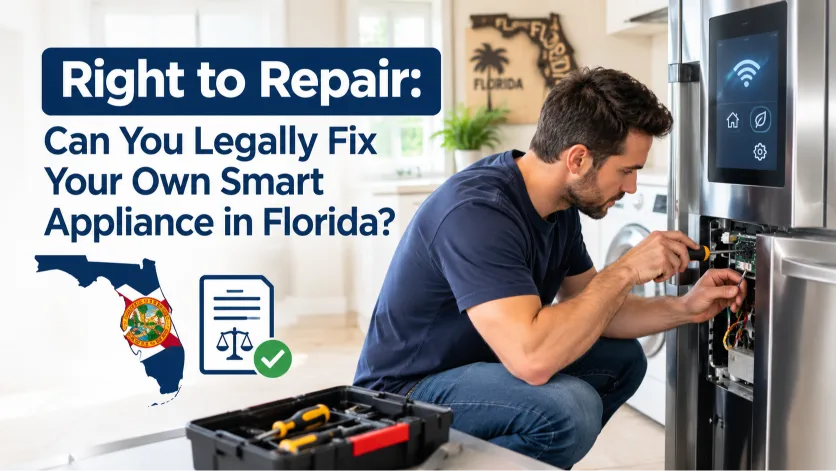
Right to Repair: Can You Legally Fix Your Own Smart Appliance in Florida?
Your fridge throws an error code you have never seen before. You Google it, and instead of an actual answer, you land on a manufacturer support page that basically tells you to schedule an authorized technician. You dig around on YouTube and the top comment under the one halfway decent repair video says “does not work anymore, they locked this out in the last firmware update.” So now you are standing in your kitchen wondering something that never used to be a question at all am I even allowed to fix this myself?
Fair thing to wonder. It is coming up more as appliances get smarter, and the honest answer is not quite the clean yes or no you will find repeated across a dozen blog posts that all clearly copied each other.
You have always been legally allowed to repair something you own. That part’s never actually been in question nobody’s needed a law granting them permission to open up their own dishwasher. That’s not really what “right to repair” means, even though the name makes it sound that way. What these laws actually target is different: forcing manufacturers to make repair information, diagnostic tools, and parts available to owners and independent shops, instead of keeping all of it locked behind an authorized dealer wall.
That’s the real fight. Not “can I pick up a screwdriver.” It’s “can I actually get the part, the manual, or the software I’d need to finish the job once I’ve started.”
And here is the part specific to where you live: Florida does not currently have a right to repair law covering household appliances or general consumer electronics. Not a guess, not going to change between now and whenever you are reading this. Worth actually walking through what does exist, because the gap between “sounds like it should exist” and “actually exists” is where most of the confusion lives.
What Is Actually on the Books in Florida
Lawmakers here have been busy with right to repair bills this session, which is exactly the kind of thing that gets flattened into “Florida passed right to repair” if you only read a headline instead of the bill text.
Senate Bill 586 creates the Right to Repair Act for Mobility Devices wheelchairs and similar equipment. Requires manufacturers to make documentation, parts, and tools available, including handling electronic security locks. Genuinely good legislation for the people it covers. Has nothing to do with your refrigerator.
SB 806 is the broader one, working through committee the Portable Wireless Device Repair Act, aimed at phones, plus a separate piece on agricultural equipment. Also real, also moving, effective date set for July 1, 2026 for whatever passes. Still built around phones and farm equipment. Kitchen and laundry appliances are not in either bill.
So compared to New York, Minnesota, California, Oregon, or Colorado the handful of states that have actually passed broader consumer electronics right to repair laws Florida is not there yet, at least not for the category that includes your fridge or washer. This session’s energy is going toward wheelchairs, phones, and tractors. Appliances are sitting this one out.
Might change. Advocacy groups tracked more than 30 right to repair bills introduced across over a dozen states in just the first few weeks of this year, and the momentum’s clearly building nationally. “Clearly building” and “already law” are two different things though, and it matters which one actually describes your situation right now.
The Federal Law Almost Nobody’s Heard Of
Here is the part that actually helps, and it is been around since 1975 long before anyone was calling anything “smart.”
The Magnuson-Moss Warranty Act is federal, so it covers Florida the same as anywhere else. One thing it does: a manufacturer generally can not void your warranty just because you used a non-OEM part, or had an independent shop work on the appliance, or did it yourself unless they can actually show that specific repair caused the exact problem you’re now claiming.
Gets misunderstood constantly, partly because manufacturers have counted on people not knowing it for decades. You have seen the sticker “warranty void if removed,” slapped over a screw. Legally shaky, and has been for a long time. If someone outside the authorized network replaces your dishwasher’s door latch and six months later the heating element dies for a completely unrelated reason, the manufacturer can not point to the latch repair as an excuse to deny that claim.
What it does not do: force a manufacturer to hand over their diagnostic software, publish full repair manuals, or sell you the proprietary parts. It protects you from being punished for going outside the system. Does not guarantee you can actually get what you would need to succeed once you’re in there. Protected to try, not guaranteed the tools that gap is basically the whole right to repair fight, shrunk down to one sentence.
Parts Pairing Is Making This Worse This Year
If you have tried fixing a newer appliance and hit a wall that felt oddly deliberate, you have probably run into parts pairing. Manufacturer software designed to only fully recognize parts that have been electronically registered to that specific unit even when the replacement part is physically identical, genuine, pulled from an identical model.
Install the “wrong” control board and the appliance can refuse to fully function until it is paired through an authorized visit. Not a hypothetical people are vaguely worried about several states are writing explicit parts pairing bans directly into new right to repair legislation this year because the practice has gotten common enough to need addressing by name.
Florida does not ban parts pairing for appliances right now. If your smart fridge or washer is doing something that smells more like intentional lockout than actual mechanical failure, that’s very likely what’s happening, and there is currently no state law making it easier on you.
Where Things Get Genuinely Stricter Not About Rights, About Safety
Separate from all of this, a few places where DIY appliance repair hits a real legal wall, and these apply in Florida same as everywhere.
Refrigerant’s the big one. Federal law under the Clean Air Act requires EPA Section 608 certification to purchase or handle most refrigerants. Not a right-to-repair issue, not going anywhere regardless of state legislation it is environmental and safety regulation. Means the sealed cooling system side of refrigerator repair genuinely is not a DIY project for someone without that certification, no matter what manuals or tools you manage to get your hands on.
Gas appliances carry their own restrictions too. Working on gas lines often requires permitting and licensed work depending on your local jurisdiction, and even where a homeowner technically can do their own gas work, the margin for getting it wrong is thin enough that most people should not treat it as a weekend project.
Neither one’s really about rights. They are about certain repairs carrying real risk to you, your house, or the environment, regardless of where the broader movement is headed.
Where That Actually Leaves You Today
- Put it all together and here is the real picture for a Tampa homeowner staring at a broken smart appliance right now.
- You can legally open it up, poke around, and attempt a repair. Nothing stops you, never has. Your warranty’s protected while you try, or if you use an independent shop, as long as the attempt did not actually cause whatever you are claiming.
- You are not guaranteed the manufacturer’s diagnostic software, error code documentation, or parts-pairing authorization, because Florida has not passed a law requiring that for household appliances the way it is starting to for wheelchairs and, soon, maybe phones.
- You cannot legally touch refrigerant without EPA certification, and gas work comes with its own licensing depending on the specific job and your local code.
- Yes, you are allowed. No, you are not necessarily equipped. Frustrating combination if you wanted a clean answer, but it is the accurate one.
Why It Actually Matters Beyond the Legal Trivia
Most of the frustration people run into is not really legal. It is practical. You own the thing. You are entitled to try. But the manufacturer holds the diagnostic keys, parts pairing is real, and unless appliance repair’s already a hobby for you, you are often stuck anyway not because the law stops you, but because the access genuinely isn’t there.
Part of why this movement’s gained so much traction has nothing to do with the legislative side at all. There is growing awareness around how much electronic waste comes from appliances tossed not because they are actually beyond fixing, but because official repair costs more than replacing, and independent repair’s blocked by design rather than necessity. That frustration’s legitimate, and it is a real part of what’s driving all these bills across the country this year even in states like Florida where the current ones do not cover appliances yet.
What This Means If Your Appliance Breaks Right Now
- If it is something the manual or app already walks you through a reset, a filter reminder, a sensor recalibration you are on solid ground handling that yourself. No legal or practical wall there.
- If it looks like a specific failed part and you can identify it confidently, sourcing a genuine replacement and installing it yourself is legal, and for plenty of straightforward jobs, entirely doable keeping in mind parts pairing might mean an activation step afterward that isn’t in your hands.
- If it is the sealed refrigeration system or a gas connection, that is where “legally allowed but inconvenient” turns into “requires certification or licensing, full stop.” Not a lockout protecting anyone’s business model. A real safety and environmental rule that exists regardless of right-to-repair.
- And if you have hit a wall specifically because of proprietary diagnostics or parts pairing rather than the actual difficulty of the repair that’s the exact thing right-to-repair advocacy is trying to fix. Just not fixed yet in Florida for this category.
Where This Is Probably Headed
Given how much is happening around consumer electronics right now, and given that appliances increasingly run on the same embedded software and connectivity already covered in some states, it is a reasonable bet Florida eventually extends something similar to household appliances. Just has not happened yet, and there’s no promised timeline.
For now, the honest answer to “can I legally fix my own smart appliance in Florida” is: yes, you can try, your warranty’s protected while you do, but you’re not guaranteed the manufacturer’s cooperation in giving you what you’d actually need to finish and anything involving refrigerant or gas is a separate, firmer line no matter where the legislation eventually lands.
If you have hit that wall and can not tell whether you are dealing with a simple fix, a parts pairing lockout, or something that genuinely needs certified hands, an actual diagnosis is usually the fastest way to find out which one you’re facing before you burn more time guessing.